
What Are Bathroom Electrical Zones? A Homeowner's Guide to Safe Bathroom Wiring
Water and electricity have never been on friendly terms, and nowhere in the home is that relationship managed more carefully than in the bathroom. Every light switch, shaver socket, heated mirror, and shower control you use each morning sits within a set of invisible boundaries designed to keep you safe. Most people never think about these boundaries until they're renovating, and that's usually when the questions start: Can I put a mirror here? Does this light need a cover? Why can't the socket go next to the basin?
The answer to all of it lies in a system most electricians simply call zoning. Understanding bathroom electrical zones isn't just useful for passing a building inspection — it shapes where every fitting in your bathroom can realistically go, long before you've picked a single tile.
This guide walks through what each zone means, how it affects the products you choose, and how to plan a bathroom that's both safe and genuinely liveable, whether you're working with a compact en-suite or a generous family bathroom.
Why Bathrooms Get Special Treatment
Under UK wiring regulations, bathrooms are classed as a "special location." That's a formal way of saying the room carries a higher risk than most others in the house. Steam, splashes, condensation, and the simple fact that skin is often wet and bare all increase the chances of an electrical fault becoming dangerous. A shock that would be a minor annoyance in a dry hallway can be far more serious in a room where you're standing on a damp floor with limited clothing between you and any live current.
Rather than banning electrics from bathrooms altogether, the regulations take a more practical route. They divide the room into zones based on distance from water sources, then set out exactly what level of protection any fitting or appliance needs within each one. The further you move from a bath or shower, the more relaxed the requirements become — right up until you're back in "normal room" territory.
This is the logic worth holding onto as you read through the rest of this guide: zoning isn't a restriction dreamed up to complicate your renovation. It's a proportionate response to risk, and once you understand the pattern, planning your bathroom layout becomes considerably easier.
The Bathroom Electrical Zones, Explained
There are three recognised zones inside a bathroom, plus the area that falls outside them entirely. Each has its own voltage and moisture-protection requirements, expressed through what's known as an IP rating (more on that shortly).
Zone 0: Inside the Bath or Shower
Zone 0 covers anywhere that can genuinely hold water — inside the bath itself, or the floor area of a shower enclosure. This is the highest-risk zone in the room, so the rules here are the strictest. Any electrical fitting used in Zone 0 must run at a maximum of 12 volts (SELV, explained below) and must be fully protected against total immersion.
In practice, very few fittings are designed for Zone 0. Underfloor heating cables laid beneath a shower tray, when installed and certified correctly, are one of the rare exceptions. As a general rule, if a product isn't explicitly rated for submersion, it has no business anywhere near this zone.
Zone 1: The Splash Zone
Zone 1 is the area directly above Zone 0, stretching up to 2.25 metres from the floor of the bath or shower, and matching the width of the enclosure or the length of the tub. Fittings here won't typically be submerged, but they will get wet — this is where shower sprays and splashes reach even with the door closed.
This is where a lot of the more interesting bathroom technology tends to live. Showers themselves, of course, sit within Zone 1 — and it's worth remembering that the shower valve, shower head, and any wall-mounted controls all need to meet the moisture protection appropriate for this zone. A shower panel with an integrated hand shower, overhead rainshower, and body jets, for instance, is built specifically to withstand this level of exposure, which is why panels of this kind are engineered as sealed units rather than an assembly of separate parts. Illuminated shower heads follow the same logic — the light source is enclosed and rated for constant water contact, so the glow you get with your morning shower isn't compromising on safety.
Zone 2: The Occasional Splash Area
Move 600mm beyond the edge of the bath or shower, in any direction, and you're in Zone 2. This area is less likely to get wet, but the odd splash or waft of steam is still possible, so fittings here still need a reasonable level of moisture protection, along with the same 12-volt SELV requirement as Zone 1.
Zone 2 is where many of the fittings that make a bathroom feel considered rather than purely functional tend to sit. Illuminated mirrors are a good example. A mirror positioned above the basin, just outside the direct splash radius of the bath but still within Zone 2, needs to be rated for that environment — which is why mirrors designed for bathroom use are built with sealed LED strips and moisture-resistant backing, rather than off-the-shelf lighting adapted for the room. The same thinking applies to any wall-mounted lighting positioned close to the washing area.
Beyond the Zones: Everywhere Else
Once you're outside Zone 2, you're in what's often referred to as "outside zones" — essentially the rest of the bathroom, where standard household fittings can generally be used, provided the room's general dampness is taken into account. This is typically where you'll find the main room lighting, extractor fan controls, and — where the layout allows for one, positioned well away from any water source — a shaver socket.
It's also where portable appliances come into the conversation. A hairdryer, for example, is fine to use in this outer area, but the flex length matters: if the cable is long enough to physically reach back into Zone 2, that changes the calculation. It's a detail that trips up a lot of people during a renovation, particularly in smaller bathrooms where "outside the zones" is a much smaller stretch of wall than they expected.
IP Ratings: The Code Worth Understanding
Every zone-appropriate fitting will be labelled with an IP rating — short for Ingress Protection. It's usually written as "IP" followed by two digits, for example IP44 or IP65. The first digit refers to protection against solid objects (dust, fingers, and so on), and the second refers to protection against moisture. For bathroom purposes, it's almost always the second digit that matters most.
As a rough guide:
- IPX4 and above means the fitting can handle splashing water from any direction — the minimum standard for most of Zone 1 and Zone 2.
- IPX7 means the fitting can withstand temporary, complete immersion — the standard required in Zone 0.
If a product has no IP rating listed at all, the safest assumption is that it isn't designed for a damp environment, and it has no place in Zones 0, 1, or 2. This single detail is one of the most common reasons bathroom electrical installations fail inspection, so it's worth checking before you fall in love with a light fitting or mirror that was never intended for a bathroom in the first place.
SELV, PELV and RCDs: The Terms That Keep Coming Up
A few pieces of jargon show up repeatedly once you start reading about bathroom electrics, and it helps to know what they actually mean.
SELV stands for Safety Extra Low Voltage. It describes a system where the voltage is kept low enough (typically 12V in a bathroom context) that even direct contact carries minimal risk, and the circuit is electrically isolated from earth. This is the standard required for Zones 1 and 2.
PELV stands for Protection by Extra Low Voltage. It's similar in principle but used in lower-risk locations, and unlike SELV, it isn't electrically separated from earth.
RCD stands for Residual Current Device — sometimes called a circuit breaker, though the two aren't quite the same thing. An RCD constantly monitors the electrical current flowing through a circuit and cuts the power almost instantly if it detects an imbalance, which is exactly what happens if current starts leaking somewhere it shouldn't, such as through a person. UK regulations require every bathroom circuit to be protected by an RCD rated at no more than 30mA. If your consumer unit is older and doesn't already have this protection fitted, it's one of the first things a qualified electrician will flag during a bathroom renovation.
None of this needs to be memorised in detail — that's what a qualified electrician is for — but recognising these terms helps you ask the right questions and understand why certain products are described the way they are.
Choosing Bathroom Fittings With Zones in Mind
Once the zoning logic clicks, it starts to inform almost every decision in a bathroom refit — not as a limitation, but as a useful filter for narrowing down what actually works in your space.
For the shower area (Zone 1): this is where the shower experience itself comes together, and it's worth thinking about it as a system rather than a single product. A concealed shower valve, an overhead rainshower, and a separate hand shower all need to sit comfortably within this zone, which is why coordinated shower panels and shower systems are designed as a single, zone-appropriate unit rather than a collection of parts sourced separately. If you enjoy a more textured showering experience, look at shower heads with multiple spray patterns — soft, massage, cascade, and mist settings all change the character of your daily routine without adding anything you'd need to think twice about from a safety perspective, since the fitting is already rated for its position in the zone.
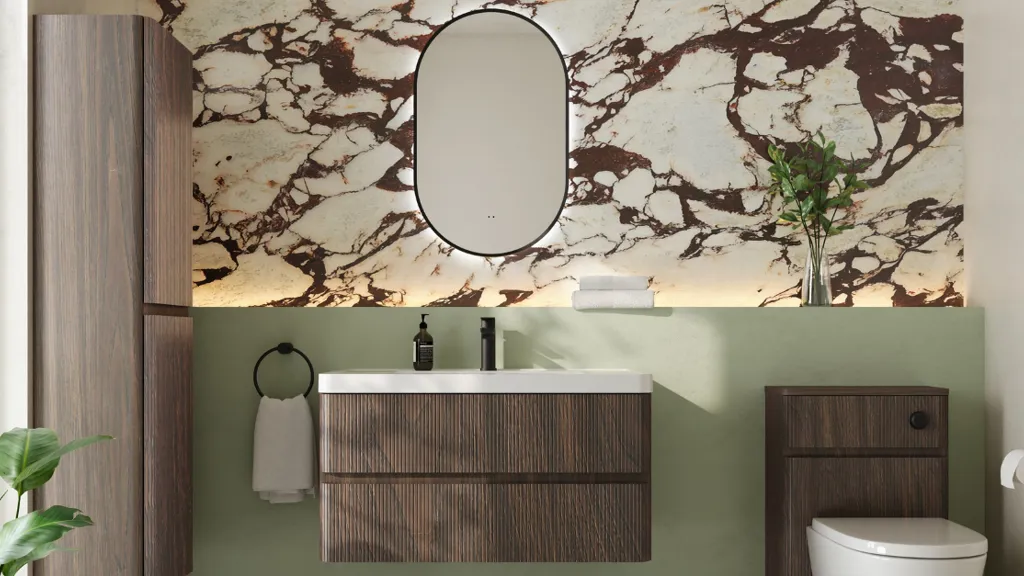
Around the basin (Zone 2): this is usually where the most personality gets added to a bathroom. An illuminated mirror above the basin does two practical jobs at once — better light for grooming and shaving, and a visual anchor for the room — while being built to handle the ambient moisture of that position. If you're drawn to a slightly more atmospheric bathroom, mirrors with adjustable light temperature let you shift between a brighter, more clinical light for the morning routine and a softer tone for an evening bath.
Water heating and wellness fittings: electric water heaters, steam generators for a steam cabin, and the pumps inside a whirlpool bath all fall under bathroom electrics too, even though they're less visible than a light fitting. These are almost always installed by a qualified professional as part of the wider plumbing and electrical first-fix, and their exact zone position is planned into the room layout from the start — which is one of the reasons it's worth finalising your choice of wellness products, whether that's a compact steam cabin or a freestanding whirlpool bath, before final wiring positions are confirmed rather than after.
Heated towel rails: these typically sit in the outer zone or Zone 2, depending on positioning, and are generally low voltage or hardwired by an electrician rather than plugged in — another reminder that final placement should be agreed early in the planning process, not bolted on as an afterthought.
The common thread across all of these is that good bathroom products don't fight against the zoning rules — they're designed around them from the outset, so the safety element becomes invisible and the focus stays on how the room feels to use every day.
Planning for Small Bathrooms vs Larger Spaces
Zoning affects small and large bathrooms very differently, and it's worth thinking about early if you're working with a compact en-suite or a tight cloakroom conversion.
In a small bathroom, Zones 1 and 2 can easily swallow most of the available wall space, leaving very little "outside zone" territory for standard fittings like a shaver socket or a non-rated light switch. This is often why smaller bathrooms lean more heavily on pull-cord switches (which are zone-compliant by design) and why every fitting — mirror, light, shower — tends to need a genuine IP rating rather than a borderline one. If you're renovating a small space, it's worth sketching the zones onto your floor plan before choosing a single product, because it will quickly tell you where a mirror can realistically sit, and where it can't.
Larger bathrooms have more breathing room, quite literally. There's more "outside zone" wall available for standard sockets, feature lighting, and heated towel rails positioned away from splash areas. This gives you more freedom to treat lighting as a design layer — a mix of a Zone 2-rated mirror light near the basin, ambient lighting elsewhere in the room, and a shower system that stands as its own focal point — without the layout constantly bumping up against zone boundaries.
Either way, the starting point is the same: map the zones first, then choose products, not the other way round.
It's also worth factoring in how you actually use the room day to day, not just its dimensions. A household that showers on a fixed schedule each morning might prioritise a shower system with strong, consistent pressure and a straightforward set of controls, while a bathroom used more for unwinding in the evening might lean towards a bath with a whirlpool function or a compact steam cabin, where the wellness element matters more than sheer speed. Neither approach is more "correct" than the other — the zoning rules simply set the boundaries within which either lifestyle can be accommodated safely.
Experience level matters too. If this is your first full bathroom renovation, it's worth leaning on a plumber or bathroom designer to walk the space with you and mark up the zones before any products are chosen, rather than trying to interpret the regulations from a diagram alone. If you've been through a renovation before, you'll likely already have a feel for how much "outside zone" wall space you actually need for switches, sockets, and storage — but it's still worth double-checking measurements against the current version of the regulations, since positions and requirements have shifted over the years.
Common Mistakes Worth Avoiding
A few issues come up again and again in bathroom renovations, and most are avoidable with a little forward planning:
- Assuming a "bathroom-friendly" product is automatically zone-compliant. Always check the specific IP rating rather than relying on marketing language.
- Positioning a mirror or light fitting without checking its distance from the bath or shower first. A few centimetres can be the difference between Zone 2 and outside the zones, which changes what rating is required.
- Forgetting flex length on portable appliances. A hairdryer or straightener left plugged in near the basin can technically stray into a zone it isn't rated for, simply because of cable length.
- Retrofitting electrics after the room is tiled. Zone positions should be finalised before first-fix wiring goes in, not adjusted afterwards.
- Assuming an older bathroom's wiring already meets current RCD requirements. Many don't, particularly in homes that haven't been rewired in the last couple of decades.
When to Call a Qualified Electrician
Bathroom electrical work in the UK is notifiable under Part P of the Building Regulations, which means it needs to be carried out by a registered electrician or signed off by building control. This applies to anything from adding a new light fitting to installing an electric shower or wiring in a heated mirror.
It's a good rule of thumb that if a job involves running new cable, fitting a new socket, or connecting anything with a plug-free, hardwired power source — think steam generators, underfloor heating, or extractor fans — it's worth bringing in a professional from the planning stage rather than the finishing stage. A good electrician won't just install the fittings; they'll help you sense-check your layout against the zones before anything is fixed to the wall, which tends to save both time and money later in the project.
Frequently Asked Questions
How many electrical zones are there in a bathroom?
UK regulations recognise three zones — Zone 0, Zone 1, and Zone 2 — plus the area outside them, which is sometimes referred to as "outside zones" or the unzoned area.
Can I have a plug socket in a bathroom?
Standard 240V sockets aren't permitted within Zones 0, 1, or 2. A shaver socket is the exception, provided it's positioned outside these zones or at least 3 metres from the edge of the bath or shower.
Do LED mirrors need to be a specific IP rating?
Yes. A mirror positioned in Zone 2 needs a minimum rating of IPX4, and ideally higher if it's likely to be closer to splash sources.
Is Zone 0 the safest or most dangerous zone?
Zone 0 carries the highest risk of the three zones, since it covers areas that can hold water directly, which is why it has the strictest voltage and protection requirements of all.
Do I need an electrician to install bathroom lighting?
Yes. Because bathrooms are a special location under UK wiring regulations, this work should be carried out or certified by a qualified, registered electrician.
Bringing It All Together
Bathroom electrical zones can feel like a technical hurdle when you first come across them, but they're really just a framework for a fairly simple idea: keep the highest-risk fittings furthest from water, and match the protection level of every product to its position in the room. Once you've mapped out where Zone 0, Zone 1, and Zone 2 actually fall in your space, choosing the right shower, mirror, and lighting becomes a much more straightforward process — and one that lets you focus on how the room looks and feels, rather than second-guessing the safety of every fitting.
Get the zoning right at the planning stage, bring in a qualified electrician for anything notifiable, and the technical side of the project fades into the background, leaving you with a bathroom that's simply a pleasure to use every day.
Because Jaquar's showers, illuminated mirrors, and wellness fittings are engineered with the correct IP ratings for their intended zone from the outset, choosing them takes the guesswork out of matching product to position. It means your renovation planning can stay focused on layout and style, with the compliance side already accounted for in the product itself. That combination of considered engineering and everyday usability is what quietly sits behind every Jaquar bathroom.


